
Announcements

2025 - Call for Abstracts/Papers: Pathways to African Feminism & Development

2025-08-12

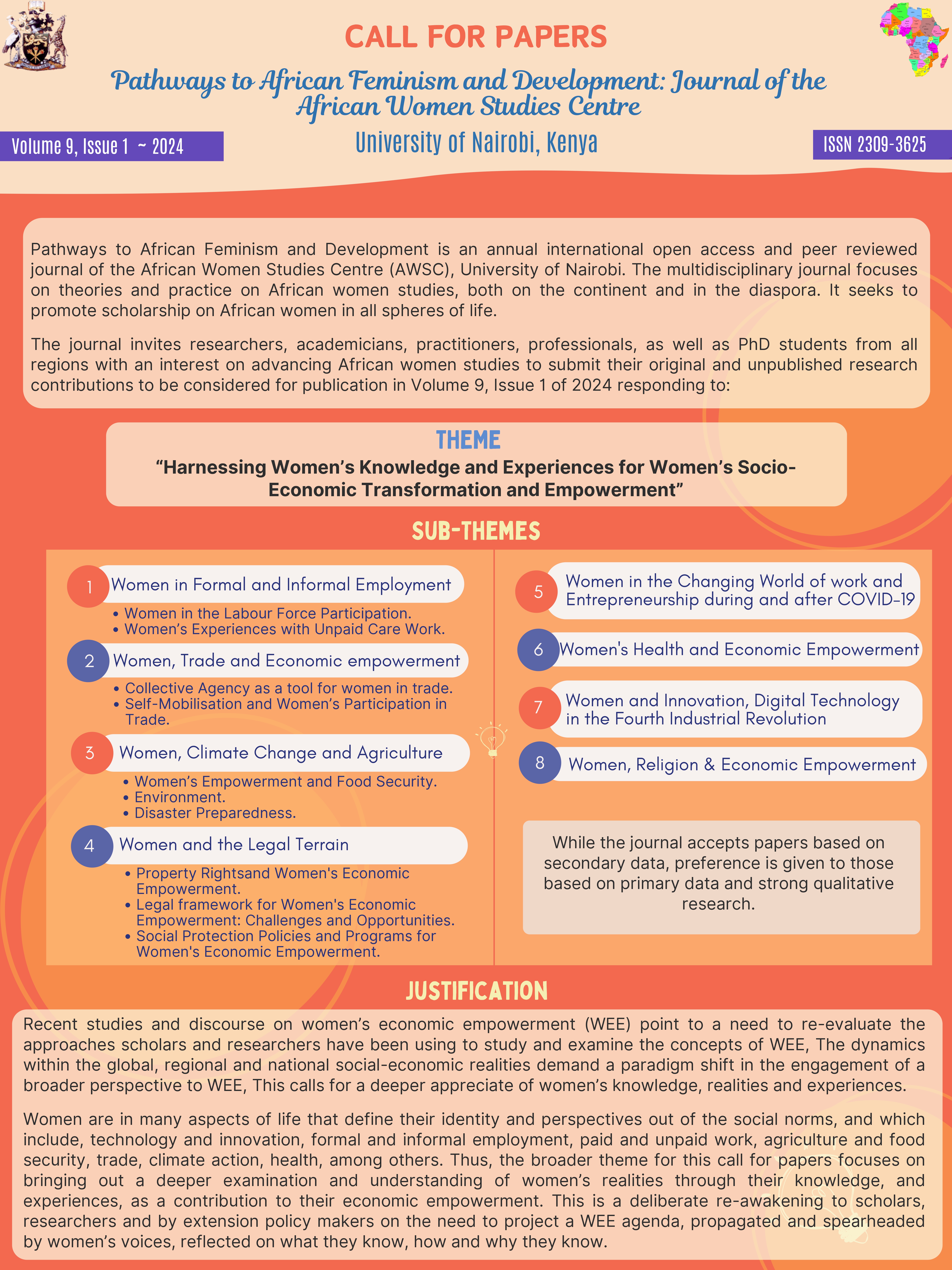
Pathways to African Feminism and Development is an annual international open-access and peer-reviewed journal of the African Women's Studies Centre (AWSC), University of Nairobi. The multidisciplinary journal seeks to promote scholarship on African women in all spheres of life, focusing on theories and practices of African women's studies, both on the continent and in the diaspora.

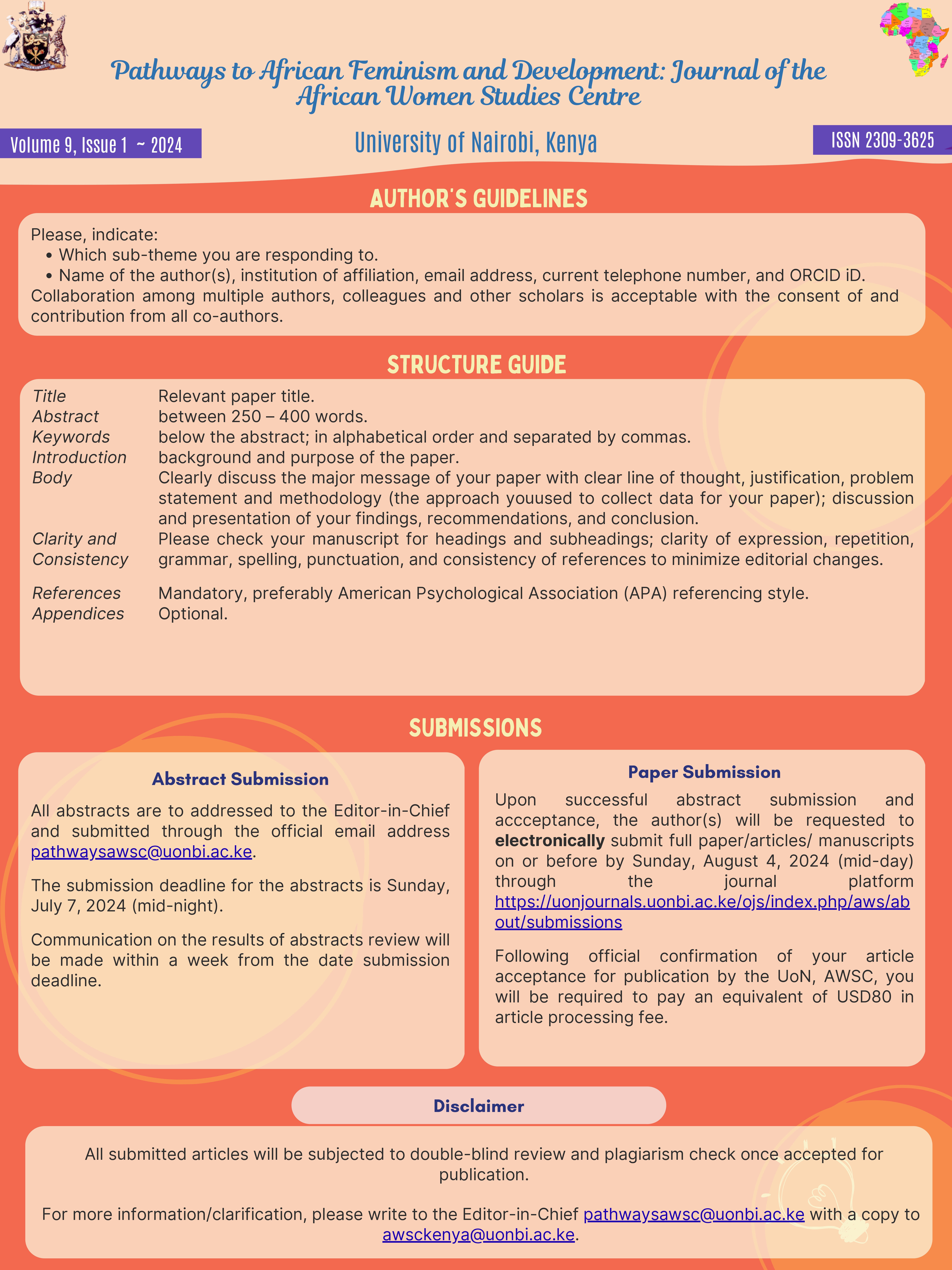
The journal invites researchers, academicians, practitioners, professionals, as well as PhD students from Kenya, the region, and globally with an interest in advancing African women’s studies, to submit their original and unpublished research contributions to be considered for publication in Volume 10, Issue 1, 2025. The submissions should align with the overarching theme and address at least one of the outlined sub-themes.

Read more about 2025 - Call for Abstracts/Papers: Pathways to African Feminism & Development
Current Issue

Vol 9 No 1 (2024): Harnessing Women’s Knowledge, Experiences for Women’s Socio-Economic Transformation and Empowerment
Pathways to African Feminism and Development - Journal of the African Women Studies Centre

It is my honour to present this latest issue of Pathways to African Feminism and Development, the open access, peer‑reviewed journal of the African Women Studies Centre (AWSC), University of Nairobi — Volume 9, Issue 1. With each publication, we reaffirm our commitment to advancing critical scholarship, feminist inquiry, and transformative knowledge on African women’s lived realities, both on the continent and across the diaspora.

This issue engages a timely and compelling theme: Harnessing Women’s Knowledge and Experiences for Women’s Socio‑Economic Transformation and Empowerment. Women have long been central to sustaining households, communities, and economies, yet their visibility and knowledge remain undervalued and underutilised. While global discourse on Women’s Economic Empowerment (WEE) has expanded significantly over the past decade, persistent gaps endure, calling for deeper scholarship, grounded evidence, and feminist theorising rooted in African contexts.

African women continue to navigate multiple and intersecting barriers in formal and informal labour markets, entrepreneurship ecosystems, climate‑affected livelihoods, and rapidly evolving digital spaces. Yet, their resilience, innovation, indigenous knowledge systems, and community solidarities remain powerful engines of transformation. These realities remind us that WEE cannot be reduced to income generation alone; it must encompass structural shifts: legal, cultural, political, technological, and environmental that enables women to exercise agency, autonomy, and voice. This requires re‑examining dominant development paradigms and advancing approaches grounded in African feminist thought, praxis, and lived experience.

The contributions in this issue reflect this richness and diversity. They interrogate entrenched narratives, highlight persistent challenges, and illuminate emerging opportunities. Collectively, they offer evidence‑based insights and recommendations for policy, programming, and advocacy, strengthening our understanding of how women’s knowledge, labour, and leadership can drive meaningful socio‑economic transformation.

As Editor-in-Chief, I am encouraged by the growing body of African feminist scholarship that interrogates, redefines, and expands the WEE agenda beyond instrumentalist approaches. This journal remains steadfast in its mission to provide a platform where scholars, practitioners, and activists generate and share knowledge that is rigorous, grounded, intersectional, and transformative.

I extend my sincere appreciation to all authors, reviewers, and the editorial team for their dedication and intellectual labour. Your contributions uphold the spirit and purpose of Pathways to African Feminism and Development: to centre African women’s voices, experiences, and knowledge in shaping development discourses and influencing meaningful change.

It is my hope that this issue will inspire further research, dialogue, and action that strengthens the pathways to women’s socio‑economic empowerment across Africa and the diaspora.

Published: 2025-11-25

Articles

View All Issues